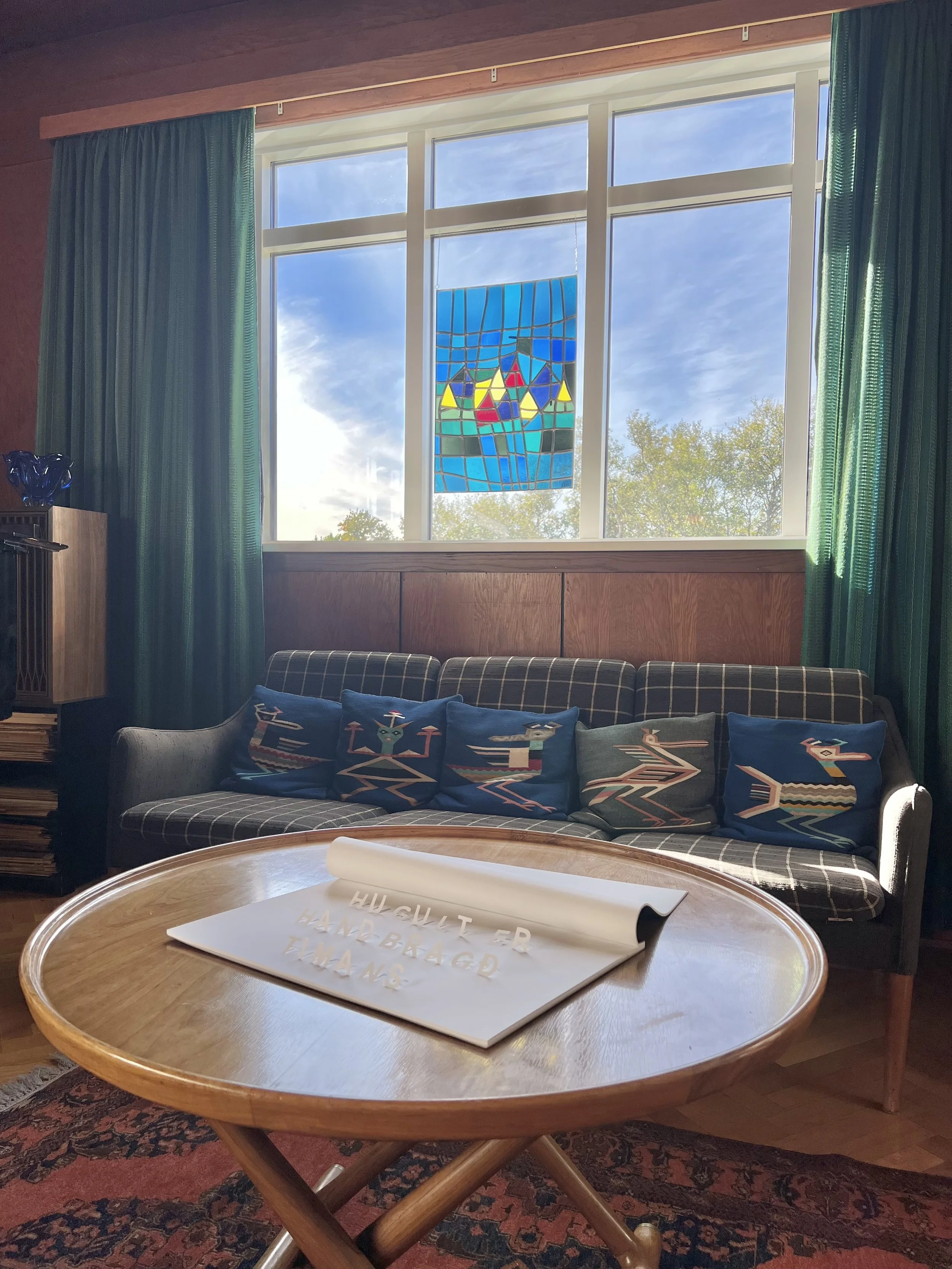
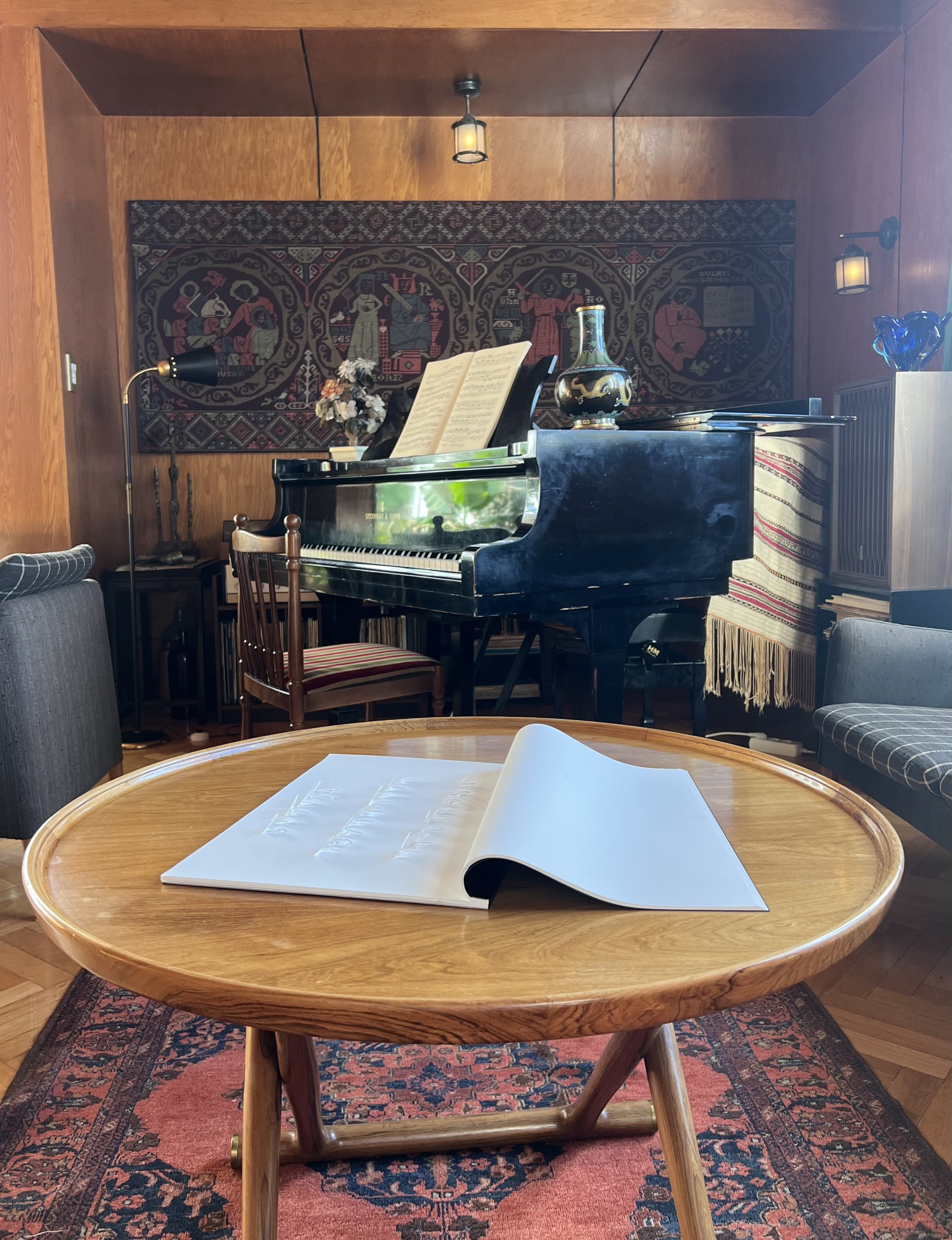
Gljúfrasteinn, the Handiwork of Time
A Picture That Does Not Disappear
Cut into stone paper ,2026
In the essay What Kind of People Settled Iceland?, published in Íslendingaspjall (1967, p. 123), Halldór, known to some as Dóri, wrote about a clear idea. The idea was simple: ever since the settlement of Iceland, spiritual ideas have revolved around the worship of stones and forces. One of its principal manifestations can be found in names such as Þorsteinn, Steinþór, Bergþóra, Þórhallur and Halldór. Hallur means stone, and sometimes we pronounce the double “ll” harshly and sometimes softly. Apparently without any pattern at all, in a completely irregular manner.
Gljúfrasteinn, and the writers’ houses in the north as well, turn our thoughts towards the passing of time, this eternal becoming of the present that eventually renders everything concerning people obsolete, except perhaps words. Everything except words. Except perhaps stories, expressions; except perhaps all that gathers dust among the public holdings of museums.
Perhaps you and I feel time working in different ways; perhaps we disagree about what it is concerned with. Some may find time cruel: in the end it brings death and causes pain; it accompanies us through conflict and physical change. It does not always treat us gently between those two points in time by which everything is measured. At the same time, it cannot be anything other than what it is. We ask nothing else of it, we do not control it, it will not become different simply because we wish it to. It works according to the same principle for everything and everyone, the same movement behind all its workings: one direction.
In the entrance hall at Gljúfrasteinn, the clock ticks eternally, but quietly. Above the door leading into the hallway is a wooden panel: centuries of prehistory, knotwork, an apology, and this beautiful word. Handiwork. More precisely: “childlike handiwork.” And behind it, all the countless stories belonging to the sitting room and the lower floor: the zebra chairs, the paintings and embroidery. A tapestry. The kitchen teeming with colour and a refrigerator of such size that it might carry us to the moon, while the muffled echo of long-vanished parties resounds gently in its own way. From the hall, the staircase leads upwards into private spaces. And there we pause at the intimate: along one wall of the bedroom, a shelf, arranged according to the mind of the one who has the final say. A Soviet book. Happiness.
One adds nothing to Gljúfrasteinn; everything is already there. Nothing is lacking, and how magnificent it all is — such beauty. This beginning, and from it an exaltation. A common victory. The timeless spectrum of white, the palette of that which no one touches. Book spines waiting by the windows, closest to the sun. Not unlike a fogbow.
And outside waits a freshly polished Jaguar, unconcerned with winter but relatively eager for the approach of spring. Waiting for its owner, or at least its next driver, while quite content to remain there as the rims, grille and beast itself are polished and the leather seats cleaned.
By the swimming pool, one looks out over the stream. The appearance of the seasons changing, now as always and for centuries to come, while the stone itself offers itself as a place to sit or to embrace. Or to whoever might know how to awaken once more the wonder of divine power in the stones, albeit with an everyday gentleness towards the elves.
Along the driveway runs a stone wall made of lava rock. There is room there for the moss; there grow the lichens that some would insist are Icelandic, though I find it strange that they could belong to a nation rather than simply to the entire universe.
Hugult er handbragð tímans — “Thoughtful is the handiwork of time” — was an idea, a sentence that came into being and was sparked by a visit to Gljúfrasteinn. I do not fully know where it came from, but I imagine it can be traced back through these ideas.
It may be that I came across the word hugull in a translation, perhaps even an AI translation. But when I thought about its meaning, and how little it is used or seems to serve any purpose, I understood why it wanted to come into being.
Almost like a proverb, or for some reason, an expression.
Perhaps even the opening half of a line. Maybe not even that, but rather simply the first part, for some reason. Something waiting for the next line.
Let it be that way. You may complete it. Please do. You are entirely welcome to spin it further if you wish.
Perhaps even with the line of poetry in mind:
All is dead without dreams.